Friday, November 30, 2012

Radical Grading

I'm obsessed with the notion of grading at the moment.  I hate having to assign a specific value to a paper, and I also hate the pressure that grades put on students because they have the potential to cultivate students who work for a grade rather than for knowledge building.  Yet, as I'm required to grade, I am trying to be as reasonable and equitable as possible.  I use a strict criteria that students must meet, and I reward complex thinking even if the writing isn't up to par.  The problem, of course, is that complex thinking is harder than I realized it would be to identify when the writing is poor.

So, I've been thinking about how I'm going to deal with this since grading is a significant part of the work that I'm getting myself into.  One idea I've been thinking about today is the idea of sticking with my grading criteria, sharing it with students on the first day of class next quarter, and offering a caveat: grade your own paper before your turn it in.  The easy answer would be to allow them to submit a re-write.  The problem with this is purely a time issue; I don't think I could reasonably look at re-writes given my responsibilities during the quarter.  However, what if I had students turn in some kind of assessment form along with the paper they turn in that says something about where they think they fell on the grading scale using my criteria?  

It might give students a sense of agency with their work and more importantly, allow them to think critically about their papers as readers rather than writers.  I've gotta do a little research, but I'm compelled by this idea.  It could be problematic when the student's grade is far higher than the one I would give, but it would be a chance for me to offer specific feedback of an area requiring improvement that they might otherwise be blind to....  Anyway, it's really got me thinking.

Thursday, November 29, 2012

Grading Papers...


is a race against time, and to make matters worse, I'm a really grumpy grader.  It's not because I think I'm brilliant and that the students I'm grading will never live up to my expectations or something like that.  Not at all.  In fact, reading their papers makes me empathize with the difficulty and complexity of expressing oneself.  In their writing, I see so many of the same errors that I make.  So, it's not from some grand high up position that I look down on these papers.  It's just frustrating when you have limited time and you keep reading for pages and pages and cannot figure out what in the heck someone is talking about or arguing for/against.

To be frank, grading just isn't nearly as "fun" as I thought it would be.  It takes me about an hour to grade each paper, and I have 30 students, so within the week that papers are turned in, I have to prepare to teach my section, complete my own reading/writing/ homework, AND grade all of the papers.  Let's just say that these pressures don't bring out the most generous attitude and commentary that I have to offer. The time pressure sets up an intense mood surrounding the papers as something I just have to get through rather than a process that I can enjoy and use as a way to get to know the students better, ya know.  

I'm really trying to fight this attitude, though.  This second round of papers is much better than the first because, in general, I can see how students' ideas are progressing after having read their first paper.  I can see them engaging more deeply in the material and finding ways to more clearly express their analysis.  It's just hard to maintain that front while I'm finding it far more difficult than I ever dreamed it would be to not fall into a deep malaise about the mountain of work that seems to always lay ahead of me.  Time management is part of it, but there is also a skill of knowing when to stop that I have not yet developed.  I'm starting to realize that I will never get on top of the workload...and that the best thing I can do for myself is to figure out how to manage the impossibility rather than try to conquer it.  

With that said, any and all tips for managing the impossible are more than welcome.

Friday, November 23, 2012

Toussaint Louverture

My work for one of my seminars and that of the class I am TA'ing for are converging at points because I am working on civil war related writings.  One figure, Toussaint Louverture, the Haitian Revolutionary, is becoming an important figure in both of these areas.  I really didn't know much about him before, and it's really too bad that I haven't encountered his name up to now because he is an important figure in history.

I thought I would share this video on his life that was done by PBS because it is a high quality segment on Haiti as the only country to have a successful slave revolution.  It's unique position in history and its tragic recreation of the same inequalities it originally sought to do away with makes it a story worth knowing.  I'm only able to upload a clip, but the full 50-minute show can be found here: http://vimeo.com/48343000


Tuesday, November 20, 2012

Workin' on it!


About a year ago to the day, I started working on a 20-page paper discussing failed roads and mobility in Octavia Butler's Parable of the Sower.  After writing that paper, I decided to embark on a project (which most of you know already) about citizenship in Parable of the Sower and its sequel, Parable of the Talents by thinking of citizenship as a form of prosthesis, which became a 60-page master's thesis.  In the meantime, I was accepted to a local conference and presented a 6-page version of the original paper on mobility, but inserted many good insights from the thesis project.

Now, I've just turned in a 12-page "version" of this same paper, which will become a 20-25 page version within the next three weeks.  You'd think I might be bored of this topic or something, but truthfully, I'm not!  Every time I sit down to do a significant revision I learn something that I didn't know before--about literary criticism and theory and about the novels themselves.  For example, my original thesis discussion involved a section on virtual reality in which I looked at how virtual reality breeds passive citizens.  Now, I've taken the passive citizens and virtual reality combo and looked at it with a more sophisticated theoretical framework, and I've become aware of the subversive nature of virtual reality.  I just re-read what I turned in today, and I can already see some of the things I suspect the professor will recommend that I reconsider when I revise it into the 20-25 page paper by the end of the quarter.

The previous academic programs I've been in have never encouraged rewriting something over time; in part because they were terminal programs with no expectation of publishing articles.  Now, I guess I'm getting a tiny taste of the process for publishing an article, which includes peer review, advisor feedback, multiple revisions, and multiple more reviews.  I'm hoping that these ideas will make their way into print at some point...if my stamina for staying interested in this project for a year now is any indication, then I should be able to make it through.


Sunday, November 18, 2012

The joy of tangents while researching!

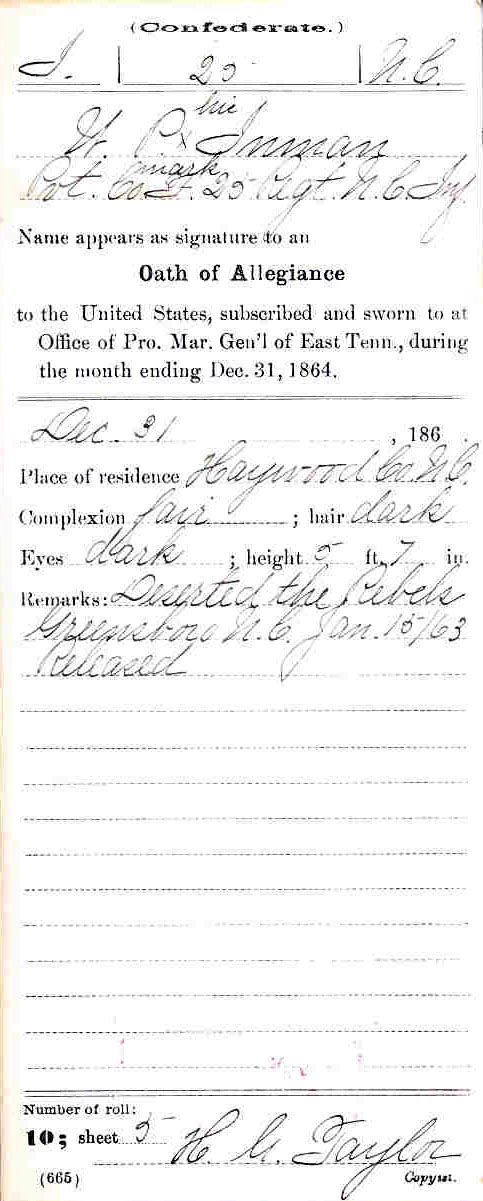
I'm currently researching a project about W.E.B Du Bois' most underrated work (in my humble opinion): Black Reconstruction in America.  In my research, I was reading a report to Congress from 1865 regarding the conditions of the post-civil war south.  Among many other things, the report talks about the oaths of allegiance that the Wade-Davis Bill of 1864 required of all former confederates and the fact that they were alternately mocked or beloved throughout the south and encouraged in newspapers.

I was wondering what the content of that oath was, but apparently it didn't actually have much content.  It was simply a card that one signed stating quite literally "oath of allegiance to the United States."  Here is a picture of such a card:


The pledge of allegiance that is said in U.S. classrooms seems in sentiment, at least, to have extended from the rifts experienced during the civil war since that is when oaths began to be required for certain people's political participation.  

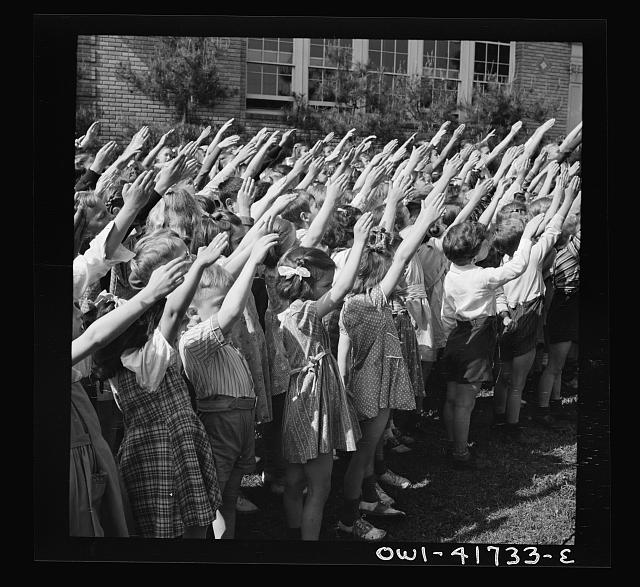
Then I got to wondering when it was that a bunch of what could be considered propaganda got thrown into the language of the pledge of allegiance and when it became necessary to say "under God", for example, and it turns out that a representative from Michigan sponsored a bill in 1954 to add it in and voila, it's what we have today.   Oddly enough, the religious part of the pledge was added in by the government, but the original language of the pledge was not actually developed by the government.  To my surprise, the pledge was authored by a guy named Francis Bellamy who was actually a Christian Socialist.  He published the pledge of allegiance in 1892 to commemorate Columbus Day in a magazine for children based in Boston called The Youth's Companion.  The pledge of allegiance was proliferated in schools, but wasn't actually adopted by congress until 1942 in the middle of WWII; the legislation was intended "to codify and emphasize existing customs pertaining to the display and use of the flag of the United States of America." Congress also included another change...the original stance for reciting the pledge was with the right arm outstretched as pictured here:


Given the timing of 1942 and the eery similarity to the Nazi salute, congress changed the stance to hand-over-heart.  I knew some of this, but it is still jarring to see American school kids in the picture above making that salute.  What a strange little history, right? 

Saturday, November 17, 2012

Thank You, Jon Stewart!

Just as I've been wondering when the mass media will start talking about reality and whatnot, Jon Stewart drops some American history knowledge on a particularly delusional member of the media in a segment called "It Was the Best of Times, It Was the Best of Times."

Apparently, I cannot embed the video here, but you can look at the clip here -- it is pretty awesome:
http://www.thedailyshow.com/watch/thu-november-15-2012/it-was-the-best-of-times--it-was-the-best-of-times

Dispelling American myths is one of my favorite pastimes!  Isn't it refreshing to talk about the truth--whether personal or political?!  I don't like the idea of living in a country where we can't be honest about our past and our present and what they mean for our future.  I really liked this segment.


Wednesday, November 14, 2012

Day 2 of getting back into the swing...

Day 2 of biking was another disaster, but I'm sticking with it.  By disaster, I mean that I made it 2/3 of the way up the hill to campus (remember that 750 foot incline in the span of 3 miles) and really could not go anymore.  I moved onto the sidewalk and out of the bike lane to give myself the option to get off and walk.  I got hot and tried to take off my helmet while still on the bike and crashed into the weeds.  Then, I had to walk the bike the final mile because I couldn't make it uphill any further!  

If only I had the four volt: 


Ahhh...but you know what, I felt GREAT afterward.  I felt tired as all hell and really out of shape, but I also felt too tired to be the anxious mess I have been lately.  In fact, I was too tired to be annoyed with the people who typically annoy me in my grad classes, which was a really good feeling.  Basically, extreme physical exertion is helping me to be a better person, and I'm totally down with that.  It seems like my body is charged with some kind of anxious energy right now that is going to go somewhere, and I would rather it spill out through my sweat on the hill than through verbal lashings or intense feelings of dislike toward other people.